

VCT is tearing down the walls around league play. Here's what's changing, and why it matters
"Everything is a tournament", "No more leagues, no more regular seasons, no more low stake matches"
LOS ANGELES – Riot Games has unveiled VCT 2027, a major overhaul of the VALORANT Champions Tour circuit that will replace the current league-heavy structure with a tournament-first ecosystem built around open qualifiers, regional LAN events, and more direct routes to Masters and Champions.
At first glance, the biggest takeaway is: VCT is becoming more open competitively. Starting in 2027, any team will be able to begin the journey to the biggest events through open qualifiers, with those paths feeding into new regional tournaments called Cups. Riot says these Cups will replace regular season league play and directly qualify teams to Masters and Champions. In the words of VALORANT Esports Global Head Leo Faria in the announcement video, “Everything is a tournament.”
But to really understand why this matters, it helps to look beyond the current 2026 format and go back to the original Tier 2 dream that defined the past few years: Ascension.
The old Tier 2 dream: make it through Ascension

For teams and players outside the tier-one leagues in 2023, 2024, and 2025, the only goal was to break into the highest level, whether that meant VCT Americas, VCT CN, VCT EMEA, or VCT Pacific.
To do that, teams had to survive their regional circuit, qualify through Challengers, and then win Ascension. In practical terms, Ascension was the main annual promotion path into the top-tier ecosystem. Only by reaching those regional leagues could teams then build toward qualification for Masters and Champions.
Ascension was dramatic and gave Tier 2 teams hope, but only in its most unforgiving form. You either made it or you did not. There was only one real promotional window each year, and if you missed it, the climb started all over again. A team could dominate much of the year, fall short once towards the end, and your entire year was reduced to a missed chance. It creates great storylines, but it also burns through too many good teams for too little reward.
Rare Atom’s repeated three runner-up finishes in Ascension CN illustrate that harsh reality well: even multiple deep runs still left a team outside the top tier if it did not actually lift the trophy.
2026 was the bridge year

In 2026, Riot already began moving away from that older promotion model.
The official season still revolves around Kickoff, Stage 1, Stage 2, and the year’s global events, but Riot also introduced a Path to Champions for Challenger teams. That route allows four Challenger teams in each region to enter the Stage 2 playoff pathway and try to fight through to Champions. From the outside, it felt like part of the transition toward the next phase of the VCT.
What matters is that we are moving away from the Ascension-era idea of promotion into Tier 1 and toward a system where teams can make repeated runs at the biggest tournaments directly.
What changes in VCT 2027
Riot says the VCT will move to a tournament model focused on three principles:
- Every match should carry more weight
- The path to global events should be open
- Live events should visit more locations.
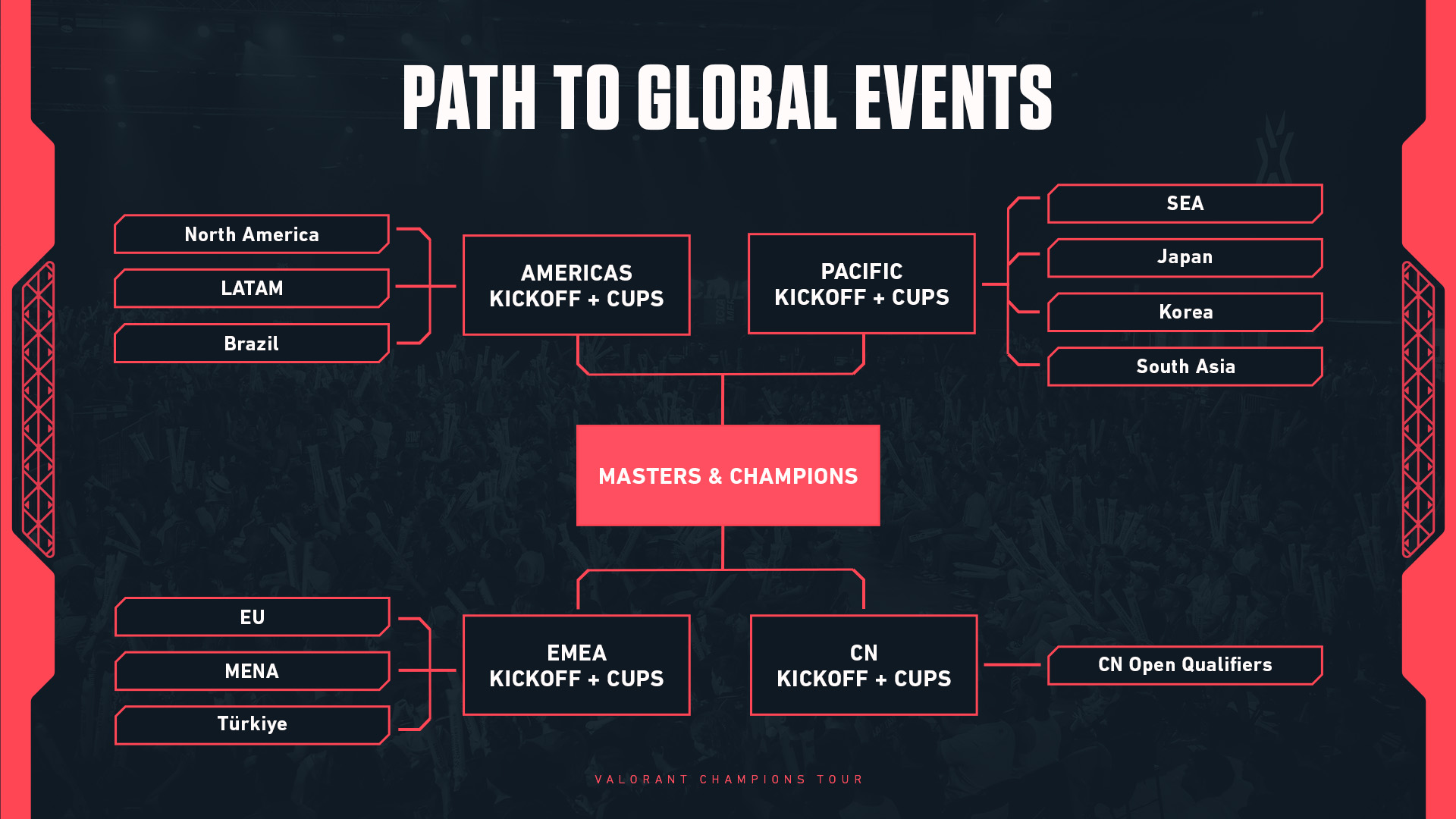
The biggest shift is that the road to all Masters and Champions events will now begin with open qualifiers. Riot says these qualifiers will be available to teams around the world, and the qualification routes may include community tournaments, partner events, collegiate events, Premier, and more.
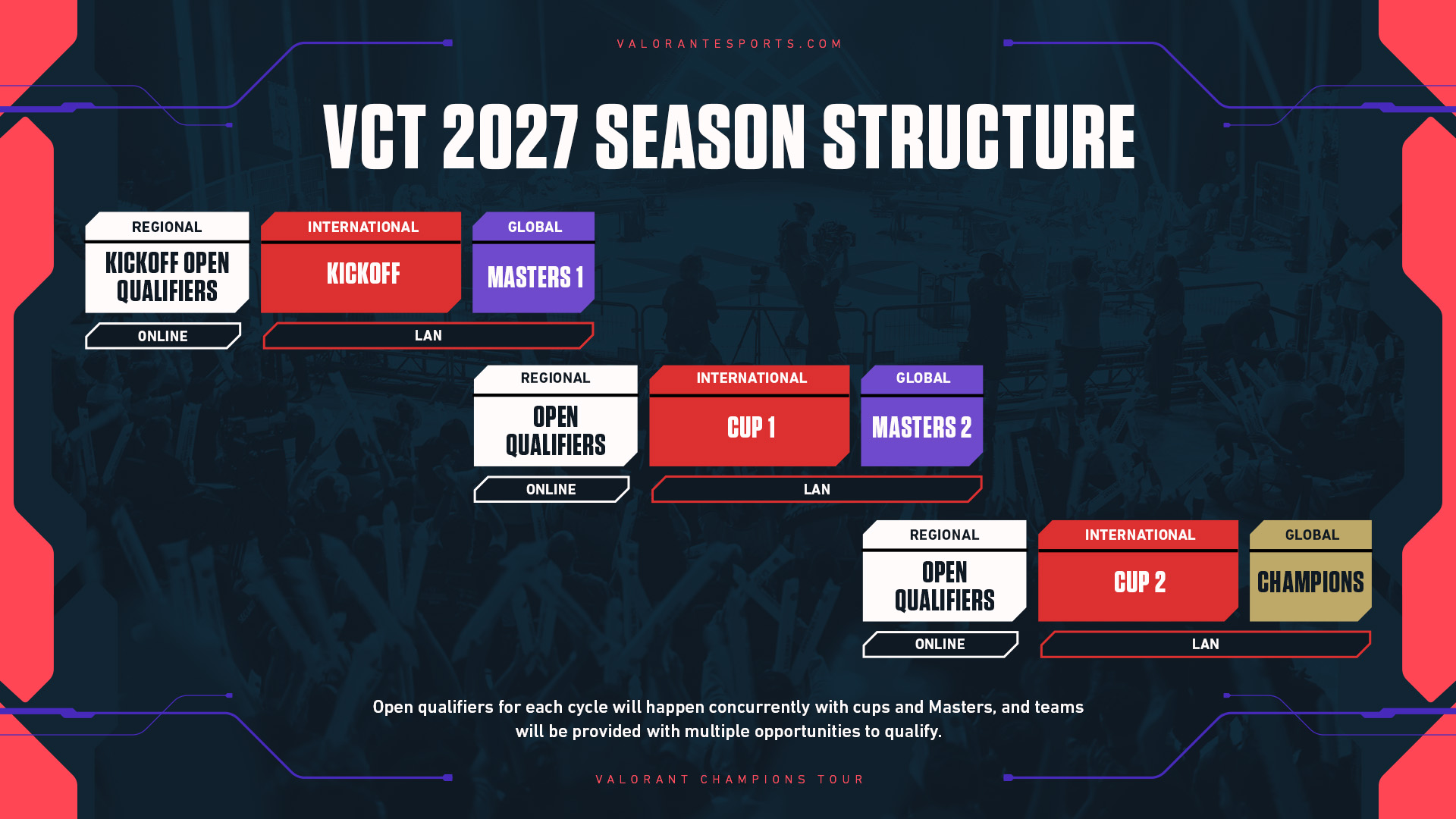
Instead of long regional league stages, these open qualifiers will feed into VCT Cups. Riot describes Cups as LAN-based events that replace regular season league play, end in a fan-facing finals weekend, and directly send teams onward to the year’s biggest events. Riot also says there will be two Cups per territory per year, eight in total.
However, region still matters. Open qualifiers may widen access, but they still feed into territory-based pathways, which means teams will likely need to be more deliberate about choosing and committing to a home region from the open qualifiers. In that sense, VCT 2027 removes some barriers, but it does not erase regional structure. It simply makes the path through those regions more direct.
Kickoff is staying too, but in a different form. In 2027, Kickoff will also be open to any team, with qualifiers held in Q4 of the previous year after Champions.
The season flow Riot lays out is much more event-driven than what fans are used to:
Kickoff open qualifiers, Kickoff, Masters 1, open qualifiers, Cup 1, Masters 2, open qualifiers, Cup 2, Champions.
In many ways, VCT 2027 feels like Riot combining the best parts of two different eras.
On one side is the open-circuit spirit of early VALORANT (2021-2022), where teams could fight their way into relevance through tournaments. On the other is the partnership era (2023-2026), which brought financial stability, commercial structure, and long-term support for selected organizations. Riot even says that in extraordinary cases, top non-partner teams could earn more than lower-performing partner teams.
For years, tier-two has been criticized for lacking proper support, and Riot’s answer now seems to be removing that separation altogether and merging everything into a single tier. Under that kind of system, the gap between teams is defined more by competitive level than by an artificial divide created through limited partnership slots. For players and smaller organizations, it also makes relevance feel less distant and less dependent on surviving a single all-or-nothing moment.
"Open Qualifiers are the only reason I was able to make a team and make our way up to what you know as Envy/Optic," Masters Reykjavík 2022 champion Pujan "FNS" Mehta reacts to the new circuit format on Twitter.
Partnership is not disappearing
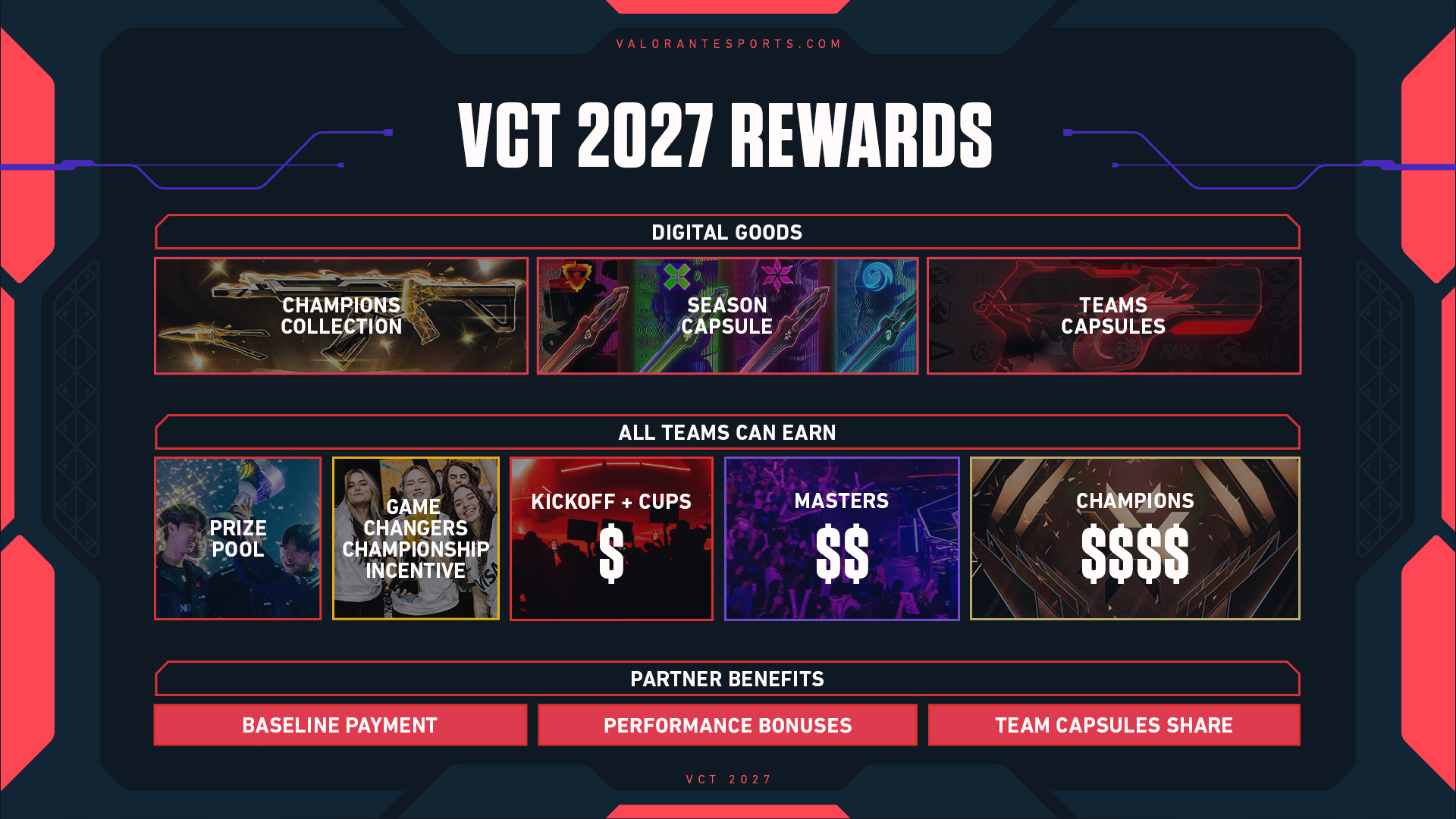
Riot is not getting rid of partnership. A new two-year partnership cycle will begin in 2027. Teams will be evaluated based on factors like community growth, fandom and content resonance, business sustainability, operational excellence, and competitive performance development.
Partner teams will still receive meaningful benefits:
- Annual base payments
- Performance bonuses
- Team capsules
- Direct seeding into later rounds of qualifiers
There will be people who dislike the fact that partner teams still keep advantages. But this is where nuance matters. A fully open circuit sounds romantic, but stability matters for a global esport. Reliable organizations matter. Operational trust matters, and it needs teams that can carry the commercial side of the ecosystem. The issue in the first partnership cycle was always whether those teams sat too permanently at the center of everything. VCT 2027 seems to answer that by loosening the gate.
More money and support deeper in the system
Riot says the new structure is meant to give more teams a path to that kind of financial upside. Tournaments in 2027 will come with:
- Qualification-based cash incentives
- Total annual prize pools of over $6 million
- Fully funded travel for global events
- Faster access to funds for Cup teams so they can handle visas and logistics
- A portion of funds dedicated to Game Changers
More cities, more live events
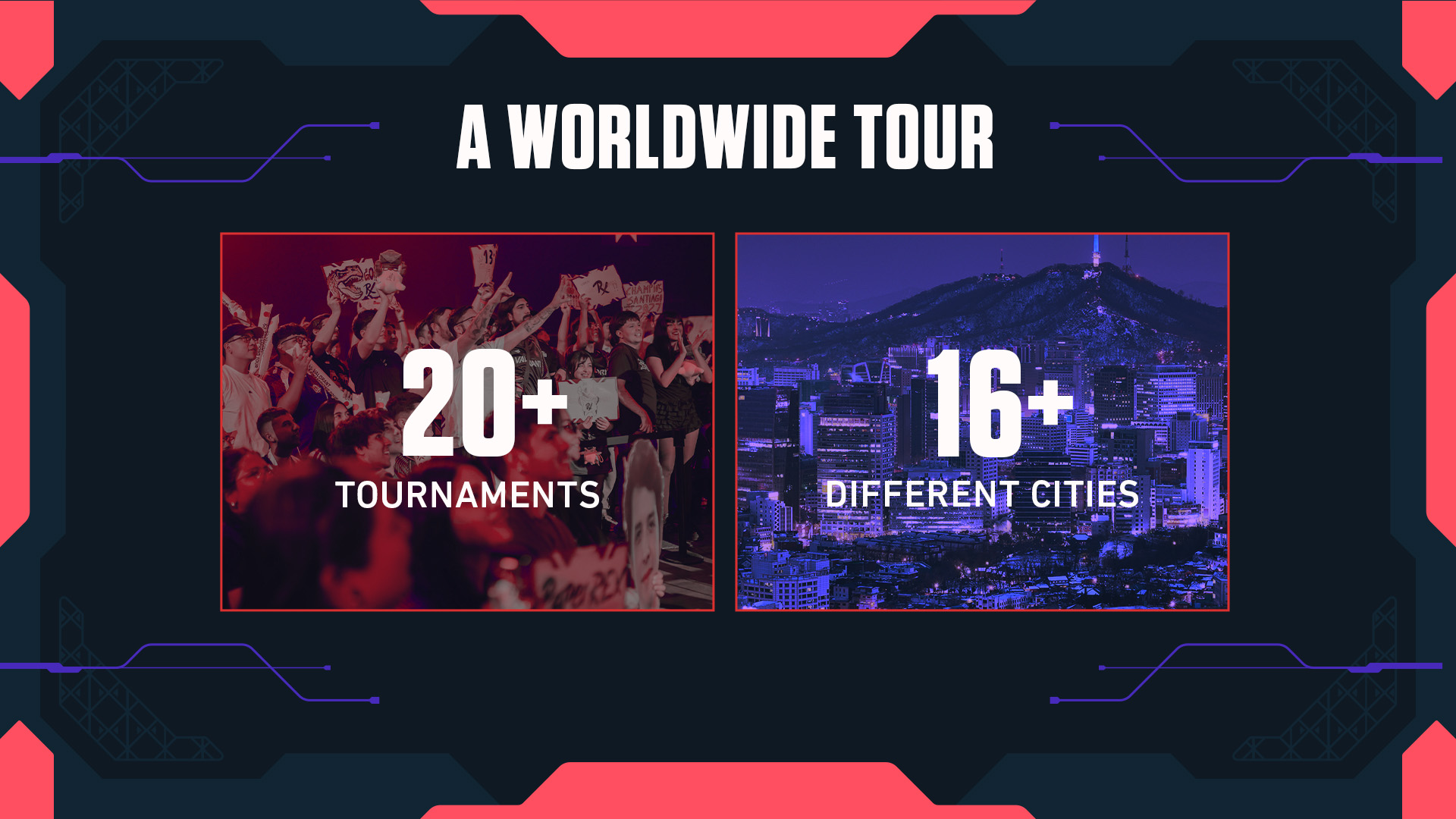
Riot says VCT 2027 will feature over 20 tournaments per year and visit more than 16 cities worldwide. Cups will be held on LAN, using a mix of Riot studios and bespoke venues, with each Cup ending in a fan-facing finals weekend.
Recent seasons have already pushed for more live events beyond the international tournaments, with China taking the show on the road across seven cities this year and other leagues hosting their season finals in different cities and countries. But VCT 2027 takes that idea much further, making the roadshow-style approach a core part of the calendar rather than just an occasional showcase.
However, there are still valid questions about whether bringing VALORANT to more cities and countries through a roadshow-heavy format could also create more visa and logistical headaches. Those problems have long affected international esports, particularly for players and teams from weaker passport countries, and they continue to surface even now, including for major organizations like Sentinels.
Final Thoughts
On paper, VCT 2027 is Riot’s most ambitious answer yet to the old problem of access in the VALORANT circuit. It does not completely tear down the hierarchy, and maybe it never was going to. But it does make the dream feel alive again.
And for an esport that has sometimes looked too polished, too segmented, and too predetermined, that might be exactly what VALORANT needs.
There is a lot to like in the direction Riot is taking, but the format’s real openness will depend on numbers we still do not have. How many partner teams stay in the picture, how many Cup spots are up for grabs, and other small details, will likely define whether the new system truly delivers on its promise.
For more insights on the Asian VALORANT scene and upcoming content like this, be sure to like and follow VALO2ASIA on Facebook, Twitter & Instagram.
Cover photo courtesy of Colin Young-Wolff/Riot Games